Cord-Cutting 2.0: How Subscription Burnout Is Sending Americans Back to Peer-to-Peer
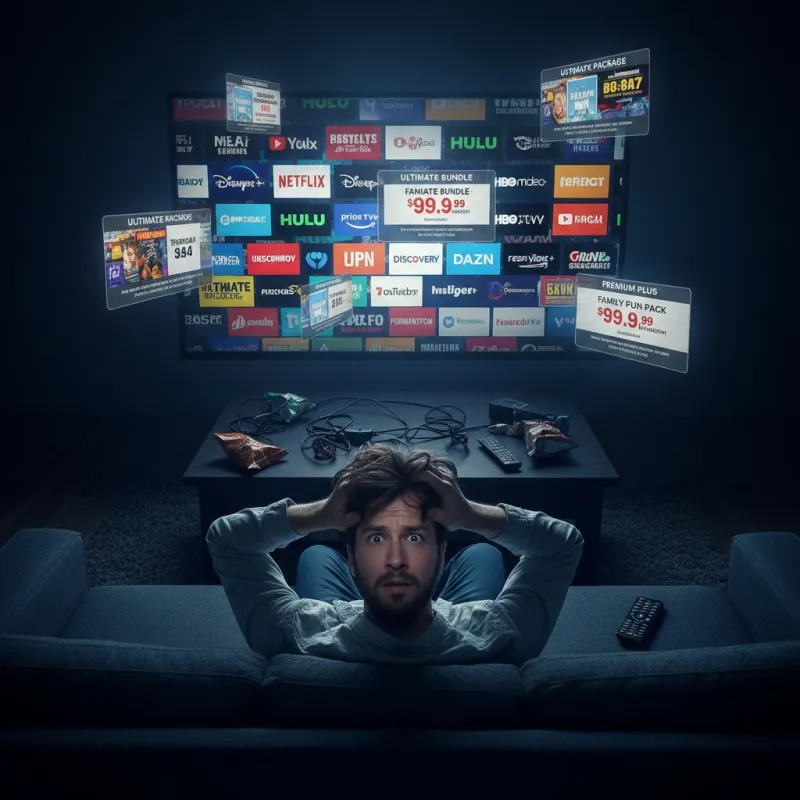
Photo: frustrated person surrounded by streaming service logos on laptop, via obrazki.ai
Remember when cutting cable felt like a revolution? You ditched the $150-a-month bundle, signed up for Netflix, and suddenly the future looked clean, cheap, and on-demand. That was the dream. Fast forward to 2025, and a lot of Americans are staring down a combined streaming bill that rivals — or outright exceeds — what they used to pay for cable. The revolution, it turns out, got monetized.
And people are fed up.
Across forums, subreddits, and Discord servers, a quiet but unmistakable rebellion is brewing. Users are canceling subscriptions, dusting off their BitTorrent clients, and rediscovering the peer-to-peer networks that predate the streaming era entirely. It's not nostalgia driving this shift — it's math, frustration, and a growing sense that the entertainment industry has broken an unspoken deal with consumers.
The Bill That Broke the Camel's Back
Let's talk numbers for a second. Netflix's standard plan runs around $15.49 a month. Add Hulu, Disney+, Max, Peacock, Paramount+, and Apple TV+ — all of which carry exclusive content you can't find anywhere else — and you're easily looking at $70 to $90 a month before you've even touched live sports, which requires yet another tier or add-on. A 2024 survey from Deloitte found that the average American household subscribes to four or more streaming services simultaneously. That's a lot of recurring charges hitting your bank account every single month.
For a lot of people, the breaking point wasn't any single price hike — it was the accumulation. One platform raises rates. Another kills its password-sharing policy. A third moves your favorite show behind a premium paywall. Each individual decision seems minor in isolation, but together they paint a picture of an industry that's quietly reversing every consumer-friendly promise it made a decade ago.
"I was paying for six services and I still couldn't find anything to watch," says Marcus, a 34-year-old IT worker from Columbus, Ohio, who asked that we use only his first name. "At some point I just thought — why am I doing this? I know how to use a torrent client. I've known for twenty years."
Marcus isn't alone. Web analytics tracking torrent indexing sites has shown consistent traffic upticks in the US following major streaming price announcements. The pattern is almost clockwork at this point.
Fragmentation Is the Real Villain
It's not just cost — it's the sheer inconvenience of the modern streaming landscape. Content licensing deals mean that a show you loved on one platform can vanish overnight and reappear somewhere else, or disappear entirely from legal availability. Studios have pulled content from their own services to avoid paying residuals. Entire seasons of shows have been quietly deleted with no warning to subscribers who thought they had access.
This kind of instability is something peer-to-peer networks don't suffer from. Once a file is distributed across a swarm of seeders, it doesn't just vanish because a licensing contract expired. The decentralized nature of P2P means that content availability isn't dependent on any single corporate decision-maker.
"Streaming is renting," explains Daria, a 28-year-old graphic designer from Austin. "You're not buying anything. You don't own anything. They can take it away whenever they want, and they do. At least when I download something, I actually have it."
That sense of ownership — or at least permanence — is something streaming fundamentally cannot offer, and it's increasingly central to why people are gravitating back toward distributed file sharing.
The P2P Landscape Has Grown Up
If you haven't touched a torrent client since the early Limewire days, you might be surprised how sophisticated the ecosystem has become. Modern P2P tools offer clean interfaces, integrated media players, RSS feed support for automatic downloads, and robust community-driven quality controls that rival anything a streaming platform's algorithm might surface.
Private tracker communities in particular have developed remarkably high standards around file quality, metadata accuracy, and community curation. These aren't the wild-west free-for-alls of the early 2000s. They're organized, often invite-only communities where maintaining good upload ratios and sharing quality files is a point of genuine pride.
Public trackers have also matured considerably. Sites aggregating torrent metadata have become more intuitive, comment sections function as informal quality review boards, and the sheer volume of available content across every conceivable format and resolution is staggering.
What This Means for the Industry
The entertainment industry has been here before, of course. The early-to-mid 2000s piracy panic eventually gave way to the streaming model, which succeeded largely because it offered a genuinely better user experience at a fair price. The lesson the industry learned — or thought it learned — was that convenience beats free.
But that equation only holds when the legal option is actually convenient and reasonably priced. When streaming becomes fragmented, expensive, and unreliable, the calculus shifts. The industry is, in some ways, recreating the exact conditions that drove people to P2P in the first place.
Some analysts have begun quietly acknowledging this. A report from Parks Associates noted that "churn" — the rate at which subscribers cancel streaming services — hit record highs in 2024. People aren't just consolidating to fewer services; many are leaving the subscription model altogether.
The Community Factor
There's also something the streaming giants consistently underestimate: the social dimension of P2P communities. Tracker forums, sharing communities, and the culture built around distributed networks create a sense of belonging that Netflix's algorithm simply cannot replicate. People discuss releases, debate quality encodes, share recommendations, and build genuine relationships around shared media interests.
For a lot of users, returning to P2P isn't just about saving money or accessing content — it's about re-engaging with a community that treats media as something worth caring about, rather than just another content unit to be served to passive consumers.
"There's people on these forums who know more about film preservation than most professional archivists," Marcus notes. "That passion doesn't exist on streaming platforms. It's just an endless scroll."
Where Things Go From Here
It's worth being clear: the streaming industry isn't going anywhere. It's too embedded in mainstream culture, too convenient for casual viewers, and too backed by corporate infrastructure to simply collapse under the weight of consumer frustration. But the assumption that streaming had permanently solved the piracy question is looking shakier by the year.
The peer-to-peer renaissance isn't a step backward — it's a recalibration. Consumers are asserting, in the most direct way available to them, that they want control over their media. They want fair prices, reliable access, and the ability to actually keep what they've chosen to watch.
The streaming industry had a window to make that case. Whether it's already blown that opportunity is a question worth watching closely over the next few years.
In the meantime, the torrents keep flowing.